

It’s exactly eight years since I wandered around a domed prison building in Arnhem, which had been transformed into an escape room, where I got the idea for my 4-book Dystopian Fantasy series. I had been racking my brain for months, trying to think of my story. But staring at a blank page never brought me anything. And not until that day in prison did I realise novel ideas won’t find you behind your computer screen. Instead, over the years, I learned that by living, you encounter new ideas in the most unexpected places. In this guide, I’ll share step by step how to find your ideas by exploring the world around you.
What makes a good novel idea?
Novels need conflict. It must be something you can’t stop thinking about. It’s the characters that feel real and have deep motivations. Or a story world that draws you right into it where you can taste and smell it. A plot that makes you turn page after page after page. But honestly, every idea can turn into a great novel as long as you have the stamina to show up for it every day. It’s all the details you, as a person with your background and experiences, pour into it that make a story unique. The question is, where do you start exploring to find your novel ideas?
How to find novel ideas by exploring the world around you
1. Go for a walk
Charles Dickens liked to go on walks. I’ve found the idea for a second novel series on a random Sunday morning walk. Whenever I go for a walk, I regularly need to pause to jot down notes on my phone. Novel ideas always seem to find me when I’m moving. Now, putting on my research goggles, I learned from Google that inspiration and movement are connected. The act of moving your body breaks through mental blocks and generates new ideas, while creativity on itself fuels physical action.
2. Explore your fascinations
The best novel idea is often that one topic you can’t stop thinking about. The thing that keeps you up at night, or that weird little guilty pleasure you try not to share with the world. But you know what? It’s exactly that topic you’re interested in that makes you capable of doing the deep dive it takes to write an entire novel or series about. And how easy is it? You don’t have to look far. It’s already right there. Writers can waste time chasing ideas they think are interesting, while ignoring the things that actually light them up. So, go and analyse that weird persistent question you can’t stop obsessing over or that dream that keeps you awake at night.
When I tried to write my first original novel, I was determined to write a standalone mystery because I had just read a book in that genre. But no great idea came to me, and instead my thoughts wandered off to Australia, the country I’d been obsessing about for years. The moment I decided to just cave in, while I was visiting the prison in Arnhem, it clicked. And a well of ideas opened up to me. So, if you’re weirdly obsessed with a particular myth, a specific decade in history, a country, or an image, follow it. Don’t feel guilty losing yourself in that obsession. It’ll lead you to the story you alone are meant to be telling.
3. Visit new places
Every new place forces your senses to become wide aware, puts you in situations outside your comfort zone and basically hands you the raw material for a story you couldn’t have invented on your own. The novel ideas for my first book series had already been living inside me for years, since Australia gave me a lifetime of writing inspiration when I first visited it in 2012.
When you’re building a story world from scratch, exploring a new place or country with its culture, habits, and history offers you a ton of novel ideas to transform into your stories. Don’t underestimate place. For some writers, place is a backdrop of their story. But what if you’d look at it as a character in its own right? When you spend time in a landscape, walking it, sitting in the grass, getting soaked to the bone, it gives you something nothing else can. Australia inspired my novel series far beyond its visual effects. After immersing myself in the land for weeks, then months, it crept into my story world and became part of it, living in the entire thing and its characters. So, all you need to do is find a landscape that does something to you and sit with it long enough to hear what it’s telling you.
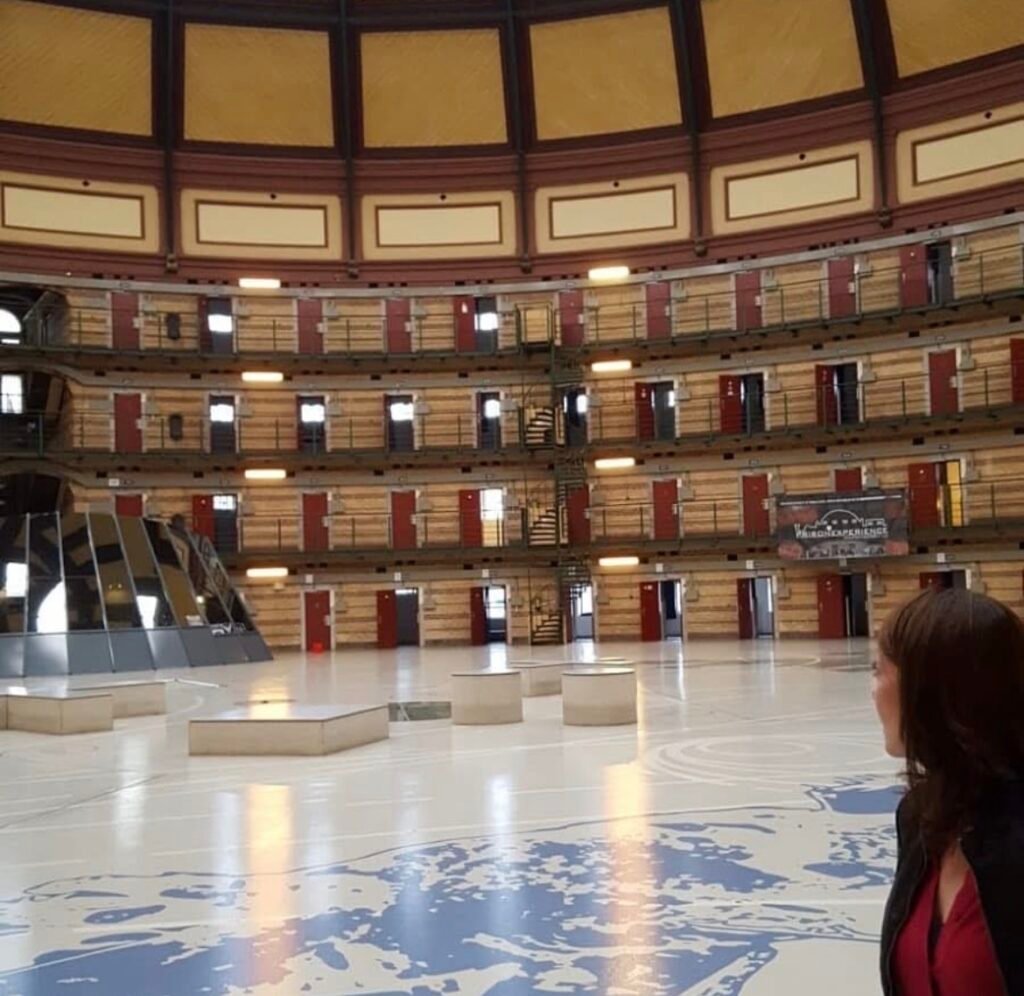
4. Plan an activity
A visit to a prison escape room was all it took for my novel series to play itself out. By putting myself in a new experience, it felt like the material for the novel ideas I needed was handed out to me on a silver platter. Make it your version of Julia Cameron’s artist date.
5. Observe people
To deepen my characters’ backstories, I’m a big fan of personality tests. But to get an idea of how certain personality traits work out in real life, watching other people is the best learning school. Meaning it won’t hurt to be social, even though it can be scary for introverted writers like us. And something I’ve just realised: I don’t create my characters based on existing people. It works the other way around. Once I’ve created a character, I meet people in real life who remind me of them, and I might “borrow” some of their traits as I write.
Because novels need friction, it’s a good thing to gather various worldviews that collide. It’s harder to manufacture that collision if everyone in your bubble thinks and lives more or less as you do. So, most fertile ground for story ideas can be found in genuine conversations with people whose daily reality differs completely from ours. Think about people with different professions, like a nurse or a truck driver. Or perhaps visit elderly locals in your hometown, have a chat with them about how things were in their youth, and discover the story that lives beneath the surface.
6. Use your senses
Writing that speaks to sight, sound, smell, taste and touch is one of the most powerful tools a writer has for pulling readers into their story world. A single well-chosen detail does more worldbuilding work than pages of direct description. The salty tang on your lips, the crunch of dry earth underfoot, the way magic feels like a prickling on skin. Most writers default to sight and neglect the rest, but scent alone can trigger memory and emotion in a reader faster than any visual description. There’s even a sixth sense worth including: proprioception, the physical awareness of your body moving through space, which adds a whole new dimension.
The best way to gather this kind of language is to go somewhere and be present in it. Writers are in-their-heads people. Well, at least I am. And when you’re in an unfamiliar place, you don’t have the luxury to run on autopilot. You actually have to look and scan your environment. But that also means you’ll notice the way light hits red dirt differently than a Dutch canal. It registers the smell of eucalyptus after rain, the eerie silence of a forest. These sensory disruptions become the material for your fiction. Although you don’t need to book a flight to Australia to get this, a town two hours from your home you’ve never visited will do its job, too.
7. Read across things you love
Stories inspire new stories. You can see that through the many tropes and retellings in every bookstore . It’s how my Dystopian Fantasy series came to life. It’s a combination of Australia, Einstein’s theory of relativity, and a prison setting. I happened to link those by accident.
Another great experiment is refurbishing genres or twisting tropes that create unlimited new story ideas or that one great twist for the plot you’ve been brooding on for weeks, but couldn’t find. Just enjoy yourself and look at it as a playground of endless possibilities.
What to do when novel ideas show up?
Well, I hope that once you try the above, your mind soon teems with novel ideas. If I’ve done my job well, you might end up on a walk or in the middle of an escape room, feeling an overflowing sense of inspiration and not knowing where to start. A luxury problem, I’d say. A simple solution is to carry a small notebook and pen in your bag. Or dedicate a digital note on your phone to jot down all your ideas. In the idea-gathering stage, it’s unimportant whether the idea is good. It’s all about brainstorming and capturing everything that wants to find you.
In a later stage, you can decide if a novel idea has the legs to carry your story. If not, that doesn’t mean the idea isn’t good. I’d recommend keeping a notebook for story ideas that don’t make it through the first stage. Novel ideas rarely find us fully formed. But when you jot down the fragments, it might become afully formed story idea when you find that missing particle months or maybe even years later. I also recommend using a physical notebook. I used to write my ideas down in a Word document and never looked at it again. These ideas went lost on me. So, just flip through the pages of your notebook occasionally, and see what it sparks within you.
Become your own novel ideas generator
You can try using tools like Artificial Intelligence or other apps to find your story ideas, but they’ll keep you in the same loop, sitting behind your desk at home. But if you step outside of your comfort zone, you might discover a whole new well of writing inspiration. That doesn’t mean it’s a guarantee. You can’t force novel ideas that are great, but you can stay in motion and remain curious. Writers who are willing to go to new places, read strange things, ask weird questions, and sit in the landscapes might find something they’d never imagined possible. So, just go out there and let those novel ideas find you.