

Your DIY writers’ retreat can be as simple as finding the perfect writing space to start writing your novel or a place to stay on your storytelling adventure. But how do you find and create a writing space that suits your specific needs?
Those who have read my other blogs know that I’m a sucker for finding writing inspiration on my travels. I’d be lying if I said that booking that idyllic cabin to open your laptop does the trick. As a nomadic writer, I’ve had my struggles to discover which environments make me thrive and which kill my creativity. Drawn from my experience, I’ve crafted this guide to help you create the perfect writing space for your creative adventures. From finding the ideal accommodation to setting up your writing space and enhancing the atmosphere, you’ll have all you need to find flow in writing on a writer’s retreat of your own creation.
Step 1: Find the perfect location for your DIY writers retreat
Your writers’ retreat starts with selecting the ideal space and location that aligns with your goals. Let me start by saying that I love to create my writer’s retreats. Every time I see the potential of finding writing inspiration in a new place, I get overly excited. However, in that excitement, I ended up booking places that ultimately distracted me from my writing focus. Think about bad working Wi-Fi, the lack of a dedicated workspace, or an overly chatty Airbnb host.
Recently, I found that for a productive writing retreat, you should pick the most boring location you can find so that you won’t face F.O.M.O. However, this rings true; I can’t entirely agree with this. I indeed get more work done in a private home setting. Still, I want my retreats and creative travels to fuel my inspiration for writing. From that perspective, I’ll share with you a few accommodation types for your writer’s retreat, along with tips and suggestions on how to make it work for you.
A. Book an Airbnb for your DIY writers retreat
The most straightforward way to plan your writer’s retreat is to book accommodation. Airbnb. This can be a room in someone’s home, a private cabin in the forest or an apartment in your favourite beach town. Airbnb even lists writer houses dedicated to people like us who crave the quiet and solitude with their novels. One space is even more cosy and more beautiful than another. The options are endless!
But I must admit I have a love-hate relationship with Airbnbs for my DIY writers retreats. Airbnbs, especially private apartments or cabins, can be incredibly expensive. To cut my costs, I’ve often rented rooms in someone’s home with no privacy or one-bedroom granny flats with only a bed to work on. Airbnbs with local hosts can be awesome if your focus is on gaining writing inspiration. I love them between deep writing retreats to refill my social battery and for all the local tips on exploring specific areas that inspire my storyworld. But if you’re in full writing mode and don’t have much money to spend, I would recommend looking into other options.
B. Guesthouses and hotel rooms
Guesthouses and hotel rooms have been great options during my creative travels. Having a private room with a desk or decent (outdoor) table to work on can make the whole thing a much more pleasant experience. Hotel rooms can be somewhat dull, though, so it depends on how much you’re willing to feel boxed between four walls.
What has surprised me most positively were my homestays in Bali. In Asia, I often book one-room accommodations in a bungalow setting, which always include a desk and/or seating outside. More than I’d expected, I got a decent amount of work done in a private setting while I was still in the midst of the buzz that fuels my writing inspiration. Booking.com is by far my favourite way to find these accommodations. It offers a broad scale of options, the app is simple, and it provides loyalty perks (through their own Genius program and the chance to link your account to various airline point programs).
C. Visit a friend who is also a writer
Invite yourself to your writer friend’s house, shut out their partner (if they have any), never change out of your jammies and write together for an entire week. Mind the silliness, but I can highly recommend making international writing friends. My bestie lives in the United States, and we have met up across continents to write together. Our first meeting was in London, where we both scribbled in our notebooks across from each other on the tube. Now, about eight years later, we still plan yearly meet-ups to indulge in a shared DIY writers retreat, where we encourage each other to focus on writing the novels we’ve been talking about for ages.
D. Build a fort in your living room
This is not a joke, and it perfectly matches the former option. And yeah, I’m totally aware I’m a tad goofy. If you have no money or options for an external writing retreat, then at least allow yourself to get creative. Find some sheets, figure out how to make a fort, string it with fairy lights and sit down with your laptop. My mantra is to step out of your usual four walls and create a writing space that allows your writing to flow. Disclaimer: I have never built a fort out of sheets, but it’s on my bucket list.
Step 2: Create a comfortable writing set-up on your writers retreat
What makes a great writing space for you? For me, it used to be my aesthetically jungle-themed office in Arnhem (including jungle wallpaper and a water bottle). I always struggled to write in cafes or other people’s homes, and it almost held me back from becoming a nomadic writer. Truth is, you’ll only learn by doing. There are enough people who don’t mind writing in any place they can find. Others might struggle more to find their rhythm and flow in writing. I belong to the latter group, that’s why I recreate a personal writing space wherever I go.
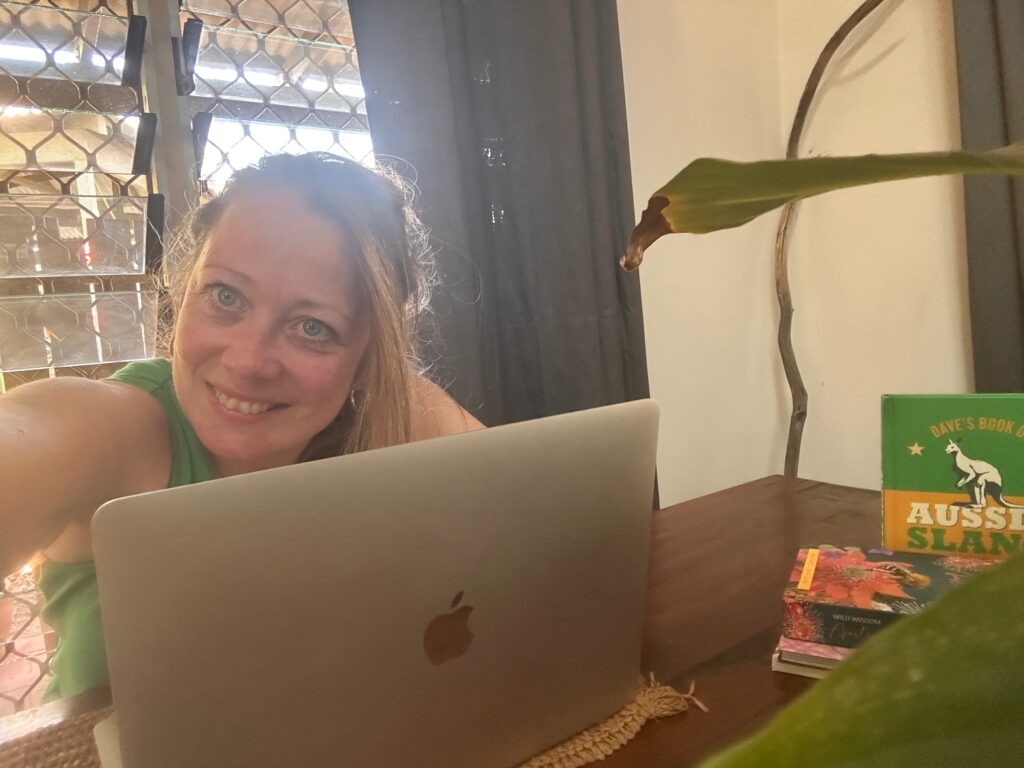
My laptop, which carries my stories, is what I now call home. Still, wherever I stay, I decorate a small corner of the space (a desk or a dining table) with the same items I brought from my old home in Arnhem. It puts me at ease and helps me transport back into my story faster. That leaves me to touch upon the most essential thing that can make or break a DIY writers retreat.
Step 3: Atmosphere as the finishing touch of your writer’s retreat
Apart from location and setting, atmosphere is the thing you don’t want to underestimate when you write a novel. For writers who find it hard to write outside their own space, think of what makes you feel at home. I really love to cook my own meals and listen to my favourite playlists. So much for being an adventurer; I’m also an introvert, and I need rhythm to withdraw into my own space, where creativity can flow. That’s why I always try to start my retreats with a non-writing day. I’ll make sure my fridge is filled, feel familiar in the neighbourhood I’m staying in, and create a sense of home with the items I’m carrying with me.
Then there’s the actual writing. What can you do to get in the mood? Here are a few things I like to do to enter your writing zone in any new place, at any given moment, in a matter of minutes.
- First things first: I always put my phone as far away from me as possible. It’s too much of a distraction if you try to focus on writing.
- Wearing my favourite piece of clothing, and cupping a warm mug of my favourite orange tea. Seriously, it helps me to find my flow in writing.
- Noise-cancelling headphones or AirPods for focused writing in case of unexpected noisy neighbours, fellow travellers or a yapping dog. These are my go-to solutions as well, if you want to write in airports or cafes.
A location inviting you to write your novel or outline a story idea. A comfortable set-up for your laptop and personal items. And a relaxing atmosphere to find flow in writing. With these three elements, you’ve got yourself the set-up for your own writer’s retreat! I realise how personal an experience can be, and no, it’s not always perfect. There are many moments when unexpected events and poorly chosen accommodations still disrupt my work. But more than that, I’ve never been as inspired to write stories as I am now. I genuinely believe that creative travel adds to your repertoire as a writer, and it’s my mission to invite you to try it out and marvel at what your adventures can bring you.